_edited.png)
Thriving in the Startup Scene: Is a Business Degree Your Ticket to Entrepreneurial Success?

In today's rapidly-evolving business landscape, entrepreneurship has become an increasingly attractive career path for many. The startup ecosystem offers opportunities for innovation, creativity, and the potential for significant impact. But does formal business education provide the foundation needed for entrepreneurial success? Let's explore insights from successful entrepreneurs who navigated this journey with business degrees in hand.

Business Education as a Foundation
Many entrepreneurs debate whether a business degree is essential for startup success. For Devarshan, Co-Founder and CTO of Koru Global Inc., his education at Arizona State University's W. P. Carey School of Business provided valuable fundamentals.
"The most impactful experience during my time at W. P. Carey was the ability to shape the educational experience that I wanted and that I was seeking," Devarshan shares. He emphasizes how the university's resources across multiple departments helped him build both academic knowledge and career readiness.
This sentiment is echoed by Yuri, Head of Finance and Business Operations at the early-stage startup TigerEye Labs, who notes the value of diverse learning: "Undergrad is such a fantastic opportunity to learn about the world, and learn about random things from really amazing professors."
Beyond the Classroom: Practical Experience
While business education provides theoretical knowledge, our interviewees emphasize that practical experience is equally, if not more, important. Hank, President of Nature's Wild Berry, reflects on his journey: "I think that it's really important for you to work in college. I think that having the cash on hand is important, but also being able to delegate your time, manage your time wisely, and then do something that is enjoyable."
For many successful entrepreneurs, college becomes a time to experiment and build skills through extracurricular activities. Devarshan credits his leadership roles at ASU for shaping his entrepreneurial journey: "In college, I made it a priority to get involved in activities that complemented my studies... I joined [a] club called Startup Village, which helped me build leadership skills, and also connect with like-minded individuals."
The Entrepreneurial Mindset
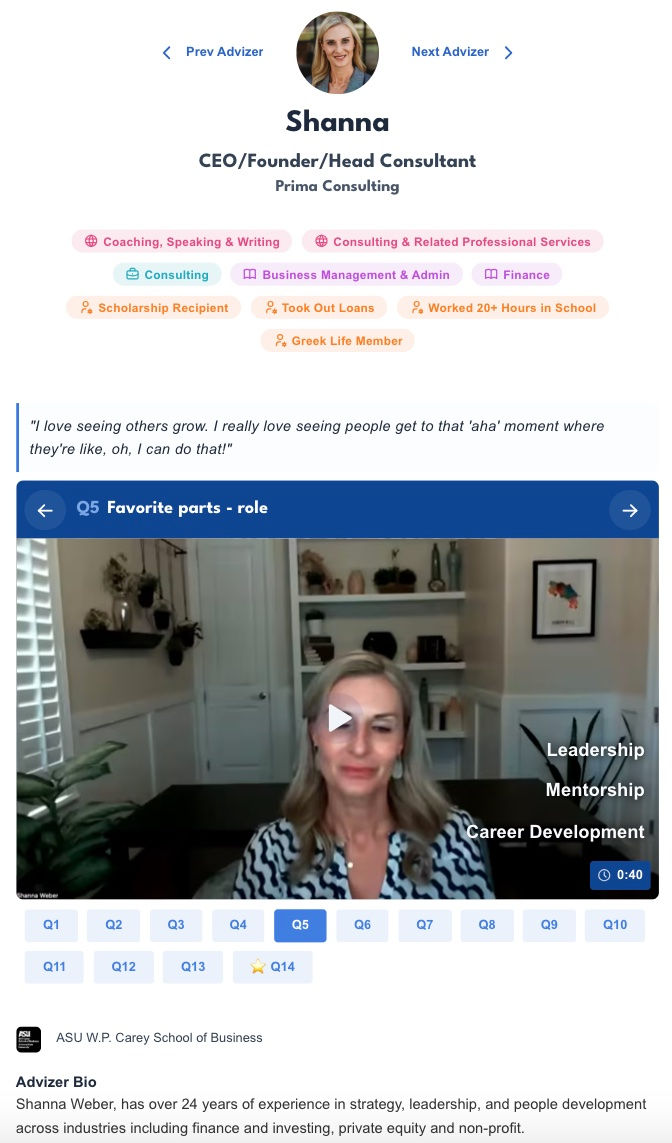
Our professionals consistently highlight that success in the startup world requires more than just knowledge—it demands a specific mindset. Shanna, CEO and Founder of Prima Consulting, emphasizes the importance of continuous learning: "I think continuously challenging yourself to grow and to learn has been something that's just driven me... I think if you stop learning, you become complacent and you stop growing."
This drive to constantly evolve and adapt is essential in the fast-paced startup environment. Devarshan elaborates on the qualities that he believes are necessary for success in his industry: "People who thrive in the industry are those who are curious, adaptable, and passionate about learning new technologies, and about
new climate, societal, and corporate sustainability issues."
Resilience: The Entrepreneurial Superpower
Perhaps the most consistent theme among our entrepreneurial advisors is the crucial role of resilience. The path to startup success is rarely smooth, and the ability to persevere through challenges is often what separates successful entrepreneurs from the rest.
"Resilience has been the key to my growth and success, especially in navigating the challenges of leading a startup and also working with stakeholders internally and externally," Devarshan reflects. "In the tech industry, things don't always go as planned, and setbacks are often part of the journey."
Hank reinforces this view, describing the relentless nature required for entrepreneurial success: "People who are relentless... with a strong vision and unwavering conviction in their mission, thrive in this industry."
Networking and Relationship Building
Business programs often provide invaluable opportunities to build professional networks that can become crucial for entrepreneurial ventures. Shanna emphasizes how relationships formed during her university years continue to benefit her: "Getting involved in [my] community, building that network, and maintaining that network over years has really helped me."
The Value of Technical Skills
While business fundamentals matter, technical knowledge increasingly provides an edge in today's startup ecosystem. Devarshan, whose background includes winning a Zoom hackathon, notes: "Participating in hackathons and pitch events also played a crucial role in developing my problem-solving abilities and understanding how to turn ideas into viable products."
He advises undergraduates to gain practical experience through "hackathons, pitch events, and business case studies," which can "give you a competitive edge to help you build a strong portfolio."
Is a Business Degree Worth It?
So, is a business degree the ticket to entrepreneurial success? The answer, according to our advisors, is nuanced. A business education provides valuable fundamentals, opportunities for networking, and exposure to diverse perspectives. However, it's the practical experiences, extracurricular activities, and development of an entrepreneurial mindset that truly prepare one for startup success. Yuri emphasizes that a broad educational foundation combined with curiosity benefits entrepreneurs: "That curiosity and that breadth of knowledge really serves you well in your future."
The Path Forward
For aspiring entrepreneurs considering a business degree, our professionals offer clear guidance:
Maximize your educational experience - Take advantage of resources across departments and seek out diverse learning opportunities.
Gain practical experience - Participate in internships, hackathons, and entrepreneurial initiatives to build real-world skills.
Build a strong network - Foster relationships with peers, professors, and industry professionals.
Develop resilience - Prepare for challenges and cultivate the mindset needed to persevere.
Never stop learning - Commit to continuous growth and adaptation in an ever-changing business landscape.
As Hank aptly puts it, "When people either laugh at your idea or say that it can't happen, you need to be able to see beyond that. That 'no' doesn't mean 'no' forever. That means 'no' right now. That means you've just got work to do to prove [it] to them, to make it so obvious to them that they're going, 'That was then. Now I'm saying yes, let's do this. We need you, we want you.'"
A business degree can provide valuable knowledge and opportunities, but entrepreneurial success ultimately comes down to what you make of those resources—and your willingness to persistently pursue your vision despite inevitable challenges along the way.
Want to learn more about how your specific background could translate into a career path? Visit us at Advize for more insights from successful, relatable professionals sharing real information to help.
If you ever want to reach out for help, advice or networking, shoot us an email at hello@advizehub.com or message us on Slack!
Wishing you success,
Emily McSherry
Founder & CEO

